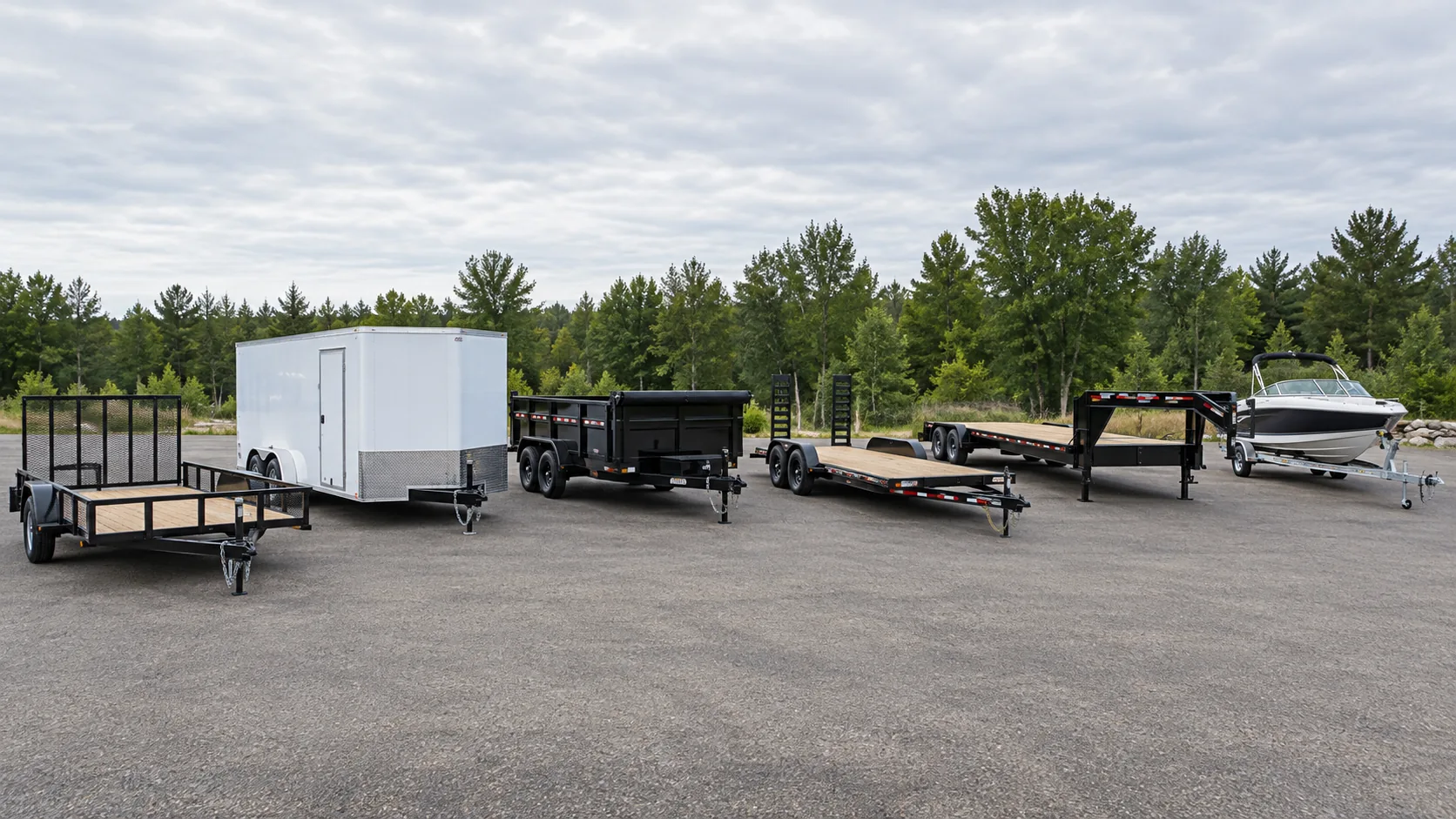
Trailer type
A utility trailer is an open-deck trailer with low rails or sides, commonly used for mowers, landscaping equipment, ATVs, appliances and project materials.
Read more →Trailer type
An enclosed cargo trailer is a roofed, walled trailer used when containment, privacy and protection from normal road exposure matter more than open access and low empty weight.
Read more →Trailer type
A car hauler is a trailer designed to load and secure passenger vehicles, with deck, ramp, fender and anchor-point choices that affect what actually fits.
Read more →Trailer type
An equipment trailer is an open trailer built around machinery loads, with capacity, deck construction, ramps and securement points selected for the intended equipment.
Read more →Trailer type
A dump trailer is a hydraulic tipping trailer for loose material, debris and some equipment, with practical capacity limited by payload before box volume in many dense-material jobs.
Read more →Trailer type
A deckover trailer has its deck above the wheels, creating full-width side access and no wheel wells at the cost of a higher deck and loading angle.
Read more →Trailer type
A tilt trailer pivots its deck to create a loading surface, which can simplify equipment loading when the tilt angle, deck length and load clearance are suitable.
Read more →Trailer type
A landscape trailer is a utility trailer equipped for commercial lawn and property work, often with a ramp gate and racks for handheld tools.
Read more →Trailer type
A gooseneck trailer connects to a hitch mounted in a compatible pickup bed, changing turning geometry and load placement compared with a rear-receiver bumper-pull trailer.
Read more →Trailer type
A flatbed trailer is an open platform for freight or equipment, selected by deck dimensions, payload, loading method and securement access rather than by length alone.
Read more →Trailer type
A boat trailer is a water-launch trailer fitted to a boat’s hull, length and total loaded weight; a trailer that only matches the boat’s advertised dry weight may be undersized.
Read more →Trailer type
A motorcycle trailer supports the bike upright and provides secure anchor geometry, adequate payload and safe loading access in either an open or enclosed format.
Read more →Trailer type
A powersports trailer is an open or enclosed trailer configured for ATVs, UTVs or snowmobiles, with fit determined by the machine’s widest and tallest travel configuration.
Read more →Trailer type
A livestock or horse trailer is designed for live-animal transport and must match the animals, loading behavior, ventilation, floor condition, partition layout and tow vehicle.
Read more →Trailer type
A concession trailer is an enclosed commercial workspace built around service windows, appliances, utilities and local operating requirements as well as safe towing.
Read more →Trailer type
A travel trailer is a towable RV with living accommodations; safe matching requires the loaded trailer, hitch weight, tow-vehicle payload and combined ratings—not only advertised dry weight.
Read more →Trailer type
A tank trailer is a purpose-built liquid carrier; liquid density, surge, tank compatibility, securement and applicable transport rules must be evaluated for the exact product and use.
Read more →Trailer type
A tow dolly carries two wheels of a compatible vehicle and leaves two on the road, so drivetrain, steering, weight, clearance and manufacturer instructions determine whether it can be used.
Read more →Choosing a trailer
The right trailer is long and wide enough for the complete load, has enough payload for its ready-to-haul weight, and stays within the tow vehicle, hitch, tire and brake ratings. Trailer length alone is not enough to make the decision.
Read more →Towing and weights
GVWR is the maximum permitted loaded weight of the trailer, payload is the cargo capacity available after trailer weight is accounted for, and tongue weight is the portion of loaded trailer weight pressing on the hitch.
Read more →Choosing a trailer
A single-axle trailer usually costs and weighs less and is easier to maneuver, while a tandem-axle trailer usually offers more capacity and a larger footprint for heavier or longer loads. The correct choice depends on the load, not the axle count alone.
Read more →Choosing a trailer
Use an open trailer when easy loading access, lower empty weight and equipment flexibility matter most; use an enclosed trailer when weather protection, containment and privacy matter more. Neither type is better for every job.
Read more →Choosing a trailer
A car hauler is designed around loading and securing vehicles, while an equipment trailer is designed around machinery and working loads; many open trailers can do both when the deck, ramps, ratings and tie-down system match the cargo.
Read more →Loading and use
A 7×16 enclosed trailer commonly works for household moves, motorcycles, tools and smaller recreational equipment, but nominal size does not guarantee fit. Check the actual interior, rear-door opening, wheel boxes, payload and tow-vehicle limits for the specific trailer.
Read more →Loading and use
Load a car hauler on firm, level ground, align the ramps, move the vehicle on slowly, position it according to the trailer and tow-vehicle instructions, and secure it with properly rated equipment before towing. Stop if clearance, stability or ratings are uncertain.
Read more →Buying and brands
Compare trailer brands model by model using frame design, crossmember spacing, axle and tire ratings, wiring protection, coating, ramp design, warranty terms, dealer support and delivered price. A strong brand can still sell a configuration that is wrong for your use.
Read more →Buying and brands
Buy new when warranty coverage, predictable condition and reduced early downtime justify the higher price; buy used when the discount is meaningful and a careful inspection confirms the frame, running gear, brakes, wiring and title are sound.
Read more →JH hands-on profile
PJ is a broad trailer manufacturer with dump, car-hauler, equipment, tilt, utility and deckover lines; JH’s direct experience is limited to the PJ B6 car and equipment hauler it operates.
Read more →Published-specification profile
Load Trail publishes a wide work-trailer lineup that includes dump, deckover, tilt, car and equipment, landscape and utility categories; the value of a unit depends on its exact configuration and local support.
Read more →Published-specification profile
Diamond C sells premium-positioned dump, equipment, tilt, utility and gooseneck trailers, but a useful comparison still starts with the exact model, rating, options and delivered price.
Read more →Published-specification profile
Big Tex offers a large work-trailer catalog and broad dealer presence, but buyers should compare the specific model’s structure, running gear, options, warranty path and local parts access.
Read more →Published-specification profile
Sure-Trac sells work-trailer categories including utility, landscape, equipment, dump, tilt and deckover models; judge a unit by its current build sheet and intended use rather than the name alone.
Read more →Published-specification profile
MAXX-D focuses on work trailers including flatbed, dump, tilt, equipment and roll-off models, with many configurations that require a model-specific rather than brand-wide comparison.
Read more →Published-specification profile
RawMaxx is commonly sold in dump, flatbed and equipment-oriented configurations; buyers should verify the manufacturer build sheet, component coverage and servicing dealer for the exact unit.
Read more →Published-specification profile
Darkhorse Cargo builds enclosed cargo trailers in multiple sizes and configurations; buyers should verify usable interior measurements, payload, construction and every option on the exact dealer unit.
Read more → Check availability